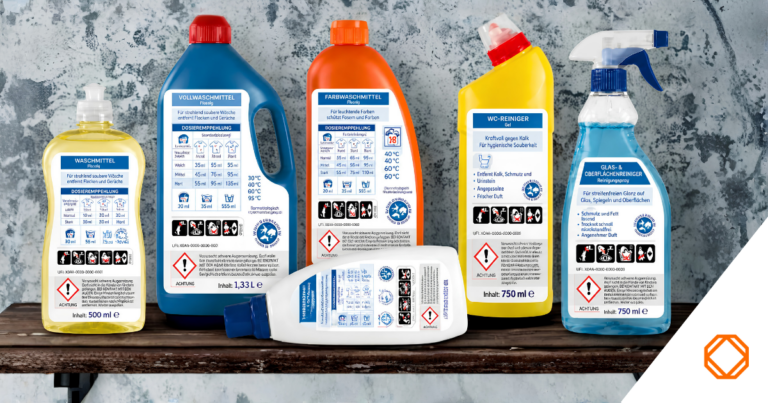
At the beginning of 2025, the ECHA’s Forum for Exchange of Information on Enforcement conducted a study[1] on compliance in the area of PCN notifications. The results have been published since February 2026 and paint a picture in need of improvement, which will presumably be accelerated in the future by stricter implementation of the applicable rules.
In addition, the Swiss reporting system has been harmonized with the PCN reporting system, although it is still not possible to use PCN dossiers for the Swiss system on a 1:1 basis.
Compliance Study
In the study “Enforcement of the notifications to the Poison Centres”, which was carried out by ECHA in the first half of 2025 and whose final report has been available since February 2026, the Forum comes to the conclusion that some of the PCN notifications show deviations.
A total of 19% of the mixtures tested were not notified, although the obligation exists. In 15% of the notifications the required UFI was missing, in 13% of the notifications there were inconsistencies between notification and labeling, in 17% of the notifications between notification and information from the SDS, especially ingredients and toxicity data.
As a conclusion and recommendation for the industry, the end of the transitional period for the harmonization of PCN notifications is pointed out once again, meaning that all parties involved in the supply chain are obliged to provide the relevant information in a structured manner. Particular mention is made of imports from other EU countries, where all information should already be REACH and CLP compliant.
Tightening up implementation
Even if there has been no concrete announcement to date, the report can be interpreted as meaning that in future the focus will be more on a uniform implementation of Art. 45 of the CLP Regulation[2] after the implementation of the notification system has been completed with the end of the transitional period.
The quality and consistency of notifications and the interlinking of PCN notifications, safety data sheets and labeling on the product will be more closely monitored in the future. The structured management of formulations, UFIs, SDSs and PCN notifications will become increasingly important.
With GeSi³ you already have a system that can perform this administration optimally and can even carry out PCN notifications directly.
Harmonization of the Swiss reporting system
The most important change, which came into force on 01.01.2026, is the end of the transitional phase of the Swiss product notification, which has been mandatory for all hazardous mixtures since this date and is now closely aligned with the European PCN notification system.
The Swiss notification requires a UFI, for products that are only placed on the market in Switzerland a special CH-UFI, otherwise an EU-UFI. It is based on Art. 48 of the Swiss Chemicals Ordinance[3] and is reported via the Swiss RPC (Register of Products for Chemicals)[4]. A representation in Switzerland is mandatory for the notification.
The reporting data is also very close to the data in the EU PCN report, only the annual market volume is additional mandatory information.
Further content and FAQs
A detailed overview of what exactly is covered by the notification obligation for PCNs and which mixtures are affected can be found in our article ” Notification obligation for PCNs – what is covered?“.
In addition, our free webinar on European Product Notification (PCN) in practice will give you an in-depth insight into implementation.
Basic information on PCN reporting can be found on our PCN information page.
For a better understanding of the entire European product notification process chain, we recommend our two-part article series The path to European product notification Part 1 and Part 2, in which the individual steps from classification to final notification are explained in detail.
In addition, our FAQ articles provide practical answers to frequently asked questions relating to the implementation of PCN requirements: in particular on deadlines and their significance, on the positioning of the UFI in the safety data sheet and on the label, as well as on UFI updates and change requirements.
Sources
[1] Pilot project on the enforcement of the notifications to the Poison Centres
[2] CLP Regulation, Art. 45
[3] Ordinance
on protection against dangerous substances and
preparations, Art. 48
[4] Swiss RPC (Register of Products for Chemicals)