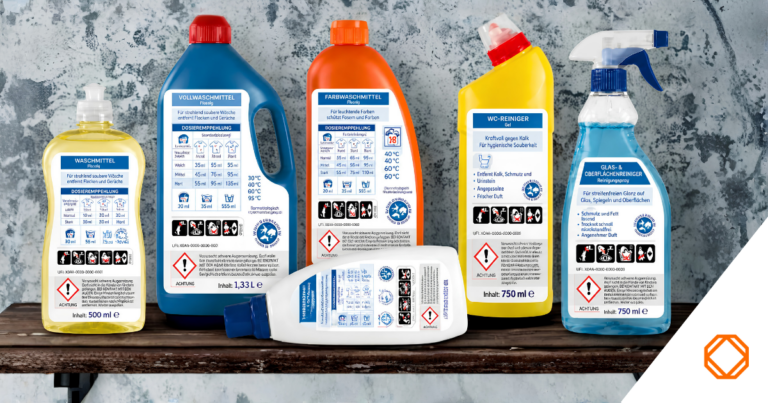
Regulation (EC) No. 1272/2008 (CLP), the law on hazardous substances at European level for the classification, labelling and packaging of substances and mixtures, distinguishes between harmful effects on the eye and on the skin. Both effects have their own classification criteria and categories. Nevertheless, the mixture classification of the eye effect also depends on the skin effect.
Categories of damaging eye effects according to the law on hazardous substances (GHS CLP)
A distinction is made between serious eye damage (category 1) and serious eye irritation (category 2). Category 1 states that damage to the eye by a hazardous substance is irreversible if it has not fully reversed within an observation period of 21 days. Category 2 includes irritations that reverse within the same observation period.
Connection between skin corrosivity and severe eye damage
It can be expected that substances and mixtures causing damage and irritation to the skin are also harmful to the eyes. This is why both the harmful effect on the eyes as well as on the skin are included in the classification of mixtures on the basis of their ingredients.
The following hazard categories are relevant to the classification “causing serious eye damage”:
- Skin corrosive in category 1 A
- Skin corrosive in category 1 B
- Skin corrosive in category 1 C
- Serious eye damage (category 1)
The proportion of all ingredients that are classified as belonging to at least one of these categories is added up. If the content of these ingredients in the mixture is 3% or higher, the mixture is classified as causing serious eye damage.
Exception: Specific concentration limit values require special addition.
Corrosive pictogram without corrosivity?
The general concentration limit for skin corrosive substances is 5%. It is therefore possible that a mixture is assigned the GHS symbol “Corrosive” (GHS 05) due to its severe effect on the eyes, while at the same time it is not classified as skin corrosive / corrosive to metals.
Sources:
Regulation (EC) No. 1272/2008 (CLP), consolidated version, as of 01/04/2016