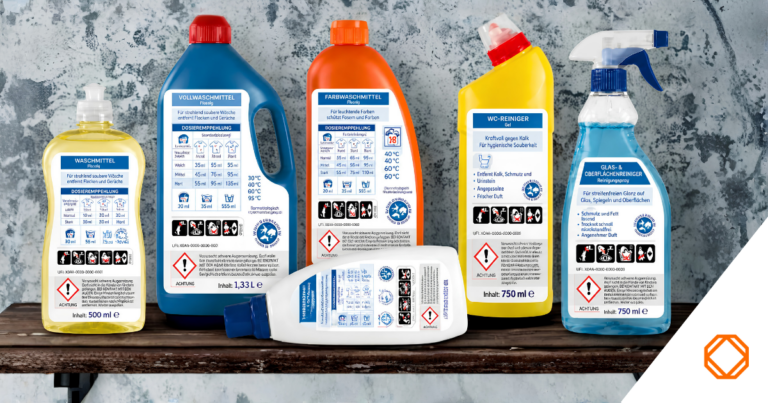
Operating instructions do not always have to be provided in the employees’ native language. Rather, it is crucial that they are understandable for the employees concerned and can be used safely in everyday working life. Particularly when working with hazardous substances in companies and laboratories, it serves to provide information about any hazards that may arise and suitable protective measures. [1,2] Why the frequently mentioned native language is not the sole legal standard for this can be classified on the basis of the GefStoffV, TRGS 555 and relevant practical instructions. [3]
Legal basis
The GefStoffV [1] and TRGS 555 [2] provide the legal basis for the creation of an operating instruction. The obligation to issue operating instructions that take into account a risk assessment is described in Section 14 GefStoffV and further specified by the TRGS. According to these specifications, the operating instructions must be provided in a form and language that is understandable for the employees. Further details on when operating instructions must be drawn up can be found here. The TRGS makes it clear that this does not necessarily mean that operating instructions must be written in the native language of the employees (Chapter 3.1 Para. 8) – this is where the information in the BAuA’s Protection Guideline 110 on the EMKG deviates from TRGS 555 and the GefStoffV.
Practical recommendations
To ensure that all employees understand the operating instructions, they should be regularly reviewed and updated.
As a practical recommendation, the TRGS refers to designing operating instructions in such a way that employees can understand them and apply them to their work. This can be achieved, for example, by using plain language [4]. This is particularly suitable for employees who only understand German at a low level – whether due to language barriers, cognitive limitations or learning difficulties. Of course, in the case of international teams, it makes sense to also translate operating instructions into the employees’ respective language of communication.
Efficient implementation with GeSi³
Modern AI-supported tools provide valuable support, especially when it comes to translating operating instructions. GeSi³ offers two practical approaches for this: By using AI, hazardous substance operating instructions can be translated extremely efficiently into many different languages since 2025. In addition, the integrated European phrase catalog (eSDSphrac, formerly EuPhraC) has been available for over 20 years and can be easily supplemented with individual phrases.
Discover the “Multilingual hazardous substance operating instructions” add-on from GeSi³ now and create hazardous substance operating instructions efficiently in several languages.
Sources
[1] GefStoffV § 14 Information and instruction of employees
[2] TRGS 555 Operating instructions and information for employees
[3] Protection guideline 110 – Organizational and hygiene measures “Inhalation”
[4] Easy language – A guide to the rules of easy language